

Someone in your town wakes up with a shoulder they can't lift over their head. They pull out their phone and type "physical therapy near me." Three practices come up in the map results.
You already know whether you're one of them.
What's less obvious is why. Most practice owners assume it comes down to advertising budget, or that the clinics on top have been around longer. Usually it's neither. It's that somebody at those practices filled in the Google listing properly and nobody at yours has looked at it since it was created.
I wanted to know how much that actually costs, so I went to the data.
Where these numbers come from
Every year, Whitespark surveys the top local search experts in the industry and asks them to score what actually moves local rankings. The 2026 edition ran 47 experts through a two-hour survey covering 187 individual factors.
One thing worth saying up front, because the report says it about itself: none of these experts have access to Google's actual algorithm. Nobody outside Google does. What they have is a decade-plus of testing and watching what happens when they change things. That's the best information available, and it's a lot better than guessing — but it isn't a leaked source file, and anyone who tells you otherwise is selling something.
I also pulled the Google listings for every physical therapy practice I could find in one Arizona city and the small towns around it — thirteen of them — to see what the picture looks like on the ground.
The shape of a small market
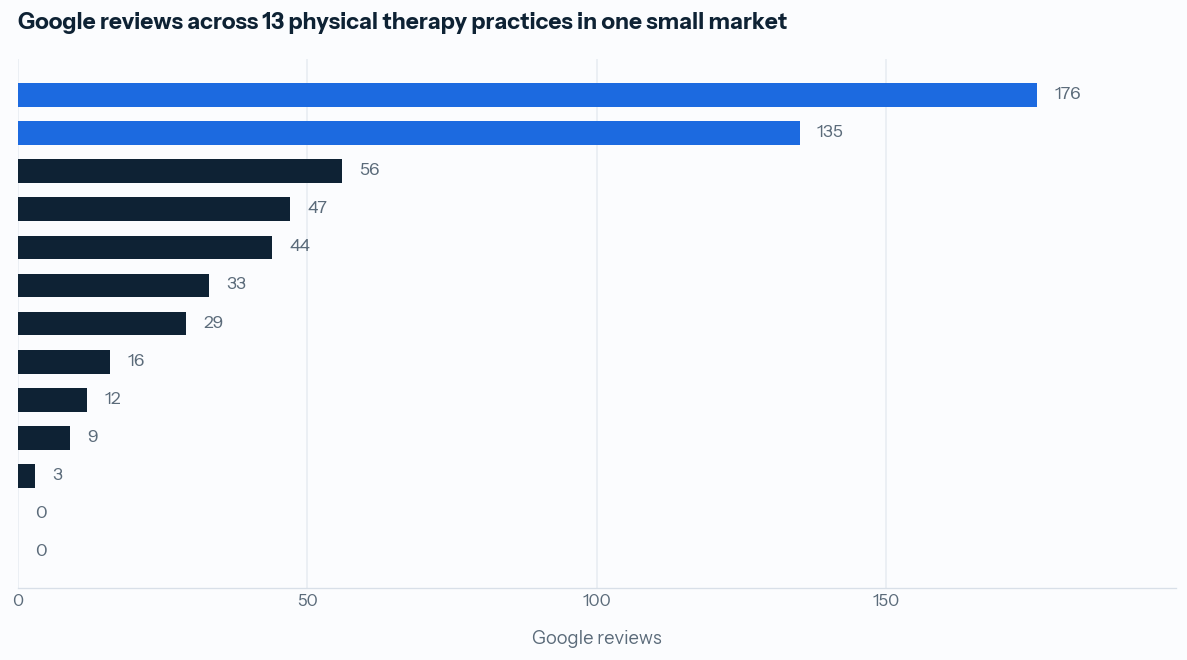
Here's what those thirteen listings looked like.
Two practices had 176 and 135 Google reviews. Every other practice in the market was under 60, and more than half were under 30. Three had fewer than five. Two had none at all.
The gap isn't quality. The practice with nine reviews averages a perfect five stars. The two at the top average 4.8. The difference between them isn't how well they treat patients — it's that two practices are asking and the rest aren't.
Your category is the single biggest lever you have
Of all 187 factors, the one the experts scored highest for map results is your primary Google category.
Not your website. Not your reviews. The dropdown you picked in about four seconds when the listing was first set up, possibly by a vendor, possibly years ago.
If your practice is categorized as "Medical Clinic" or "Physical Fitness Center," you are competing in the wrong race. Google is matching categories to searches, and "physical therapy clinic" isn't what you told it you are.
What to do: Open your Business Profile and look at the primary category today. It should say "Physical Therapist" or "Physical Therapy Clinic." Then add secondary categories for what you actually do — sports medicine clinic, occupational therapist, if they genuinely apply. Additional categories ranked eighth on the same list.
Your hours are a ranking factor, not just information
This is the finding that surprised me most, and it's the one I'd want to know if I ran a clinic.
Whether your business is open at the moment somebody searches ranks fifth out of 187 factors for map results. Not whether your hours are listed. Whether you are open right now.
Whitespark's Darren Shaw describes watching it happen in real time: a business sitting at the top of local results starts sliding roughly an hour before closing, and once it's actually closed it gets displaced by competitors who are open.
For a physical therapy practice this matters more than for most businesses. If you close at noon on Friday, you are progressively invisible from about eleven on — through the entire Friday afternoon when somebody who tweaked their back at work is looking for help. If your hours are blank or wrong, Google may be treating you as closed constantly.
What to do: Check that your hours are set and accurate, including holidays. Separately, having your hours set correctly at all ranks 21st.
One caution: don't inflate your hours to game this. Google's guidelines prohibit it, and a patient who drives to a locked door writes the review that undoes the gain.
Reviews: the count matters, but so does the rhythm
Your star rating ranks sixth. The number of reviews with actual text ranks ninth.
Then two more that most practices never think about. How recent your reviews are ranks eleventh. And a steady flow of reviews over time, rather than bursts, ranks fourteenth.
That last one quietly rules out the thing most practices try first. Emailing every patient from the last three years and getting twenty reviews in a week is a burst. It looks unnatural because it is unnatural, and the research says steady beats spiky.
Two or three reviews a month, every month, will do more than thirty in a weekend.
What to do: Build asking into your discharge routine rather than running a campaign. The patient who just finished a course of care and can lift their arm again is the one who'll write something worth reading. I wrote about how review volume and recency interact with rankings in more detail here.
A note for medical practices specifically: be careful about how you respond to reviews publicly. HIPAA protects patient information even when the patient brought it up first, and confirming that someone was your patient in a public reply is itself a disclosure. Be careful, too, about offering anything of value in exchange for a review — for a practice billing Medicare, that runs into the Anti-Kickback Statute. Ask. Don't incentivize.
The listing you forgot you had
Two of the sixteen practices I looked at had a second location listed on Google under a variation of the owner's name, with no hours, no reviews, no rating, and no photos. Both were real, operating locations of practices that were doing fine at their main site.
To Google, and to a patient, those listings look like a business that closed.
This is a specific and common failure: a practice opens a second location or moves, a listing gets created, and then nobody ever claims it. Meanwhile "Verified GBP" ranks 29th, and having your physical address in the city being searched ranks fourth.
If you have a satellite location, an old listing from a previous address, or a listing under a former practice name, it is either helping you or actively telling people you're closed. There is no neutral.
What to do: Search your practice name on Google Maps, then search your address, then search the name of any location you've ever operated. Claim anything you find. Delete or merge duplicates.
Your website and your listing have to agree
The address, phone number, and practice name on your website matching what's on your Google listing ranks 15th.
This sounds like housekeeping and mostly is. But it breaks in a predictable way: you move, or change phone systems, and the website gets updated while a dozen directory listings keep the old details. Now there are two versions of your practice on the internet and Google has to guess which is real.
What to do: Pick one exact format — including whether you write "Suite 5" or "Ste. 5" — and make your website, your Google listing, and every directory match it character for character.
What matters less than you've been told
This is where the data gets genuinely useful, because it contradicts advice you have almost certainly been given.
Replying to every review. Owner responses to most reviews rank 122nd of 187. Putting keywords in those responses ranks 182nd — nearly dead last.
Respond to reviews because a prospective patient reads them and it's decent practice. Don't do it believing it moves your ranking, and definitely don't stuff "physical therapy in [your city]" into the replies.
Posting to Google constantly. How often you post ranks 148th. How many posts you have ranks 168th.
Title tag length. Ranked 184th of 187 — the report's author calls it an SEO myth outright and notes that Google will happily use long titles.
If an agency is charging you monthly to write Google posts and reply to reviews with keywords in them, you now know roughly what that's worth against fixing your category and your hours.
The honest summary
Nearly everything above is free and most of it takes one afternoon. Category, hours, claiming a stray listing, making your website match your listing — none of that requires a budget or a consultant.
Reviews take longer because they require a habit rather than a task. But a practice going from nine reviews to forty over a year, steadily, changes its position in a small market. In the market I looked at, forty reviews would move a practice from the bottom third into the top five.
The practices winning local search in your town are not better at physical therapy than you are. They just filled in the form.
Want to know where your practice actually stands?
I'll look up your Google listing, compare it against the other physical therapy practices in your area, and send you a plain-English summary of what's different — your categories, your review count against theirs, any duplicate or unclaimed listings, and whether your website and listing agree.
It's free and it takes me about twenty minutes. No pitch, no obligation, and I won't put you on a mailing list.