

Search "physical therapy" plus your city and look at what comes back. Three clinics sit at the top of the map results. One has 180 reviews. You have 14.
It's a deflating moment, and the question that follows is always the same: how many do I actually need?
Here's the honest answer, and then the useful one.
Nobody can give you a number — and be skeptical of anyone who does
There is no published threshold. No study says "get to 47 and you'll rank." Google doesn't disclose it, and the number would be meaningless anyway, because local rankings are relative. You're not competing against a national benchmark. You're competing against the three practices currently sitting above you in your city.
A practice in a small market and a practice in Phoenix face completely different review landscapes. Any article that hands you a universal number is guessing.
What does exist is solid research on which review signals carry weight and how they rank against every other ranking factor. That's more useful than a number, because it tells you where to spend your effort.
Where the data comes from
The most-cited resource in local SEO is Whitespark's Local Search Ranking Factors report. For the 2026 edition, 47 local search experts each completed a two-hour survey scoring 187 individual ranking factors.
One caveat worth stating plainly, because the report itself states it: none of these experts have access to Google's actual algorithm. These are informed estimates from people who optimize local businesses full-time, not leaked internals.
The report's author, Darren Shaw, summarized the headline change this year: the biggest shifts for 2026 are an increased importance of review signals and behavioral signals.
Where reviews actually rank
Out of 187 factors scored for Google's local pack and Maps results, four review-related signals land in the top fifteen:
- #6 — High numerical Google ratings (4–5 stars)
- #9 — Quantity of native Google reviews with text
- #11 — Recency of reviews
- #14 — Sustained influx of reviews over time, rather than bursts
Read those last two again, because together they're the most important thing in this article.
Recency ranks 11th. Steady accumulation ranks 14th. Both sit within a few places of raw quantity at 9th. In other words, according to the people who study this professionally, when your reviews arrived and how consistently they keep arriving matter nearly as much as how many you've collected in total.
That reframes the whole problem. The clinic with 180 reviews has an advantage on quantity. But if those reviews stopped arriving two years ago and yours are arriving every month, you're competing on two of the three signals — and gaining on the third every month.
You don't have to catch up in one leap. You have to not stop.
The detail almost nobody acts on: reviews with text
Look closely at the difference between two factors in that same table.
Reviews with text rank 9th. Star ratings with no text rank 38th.
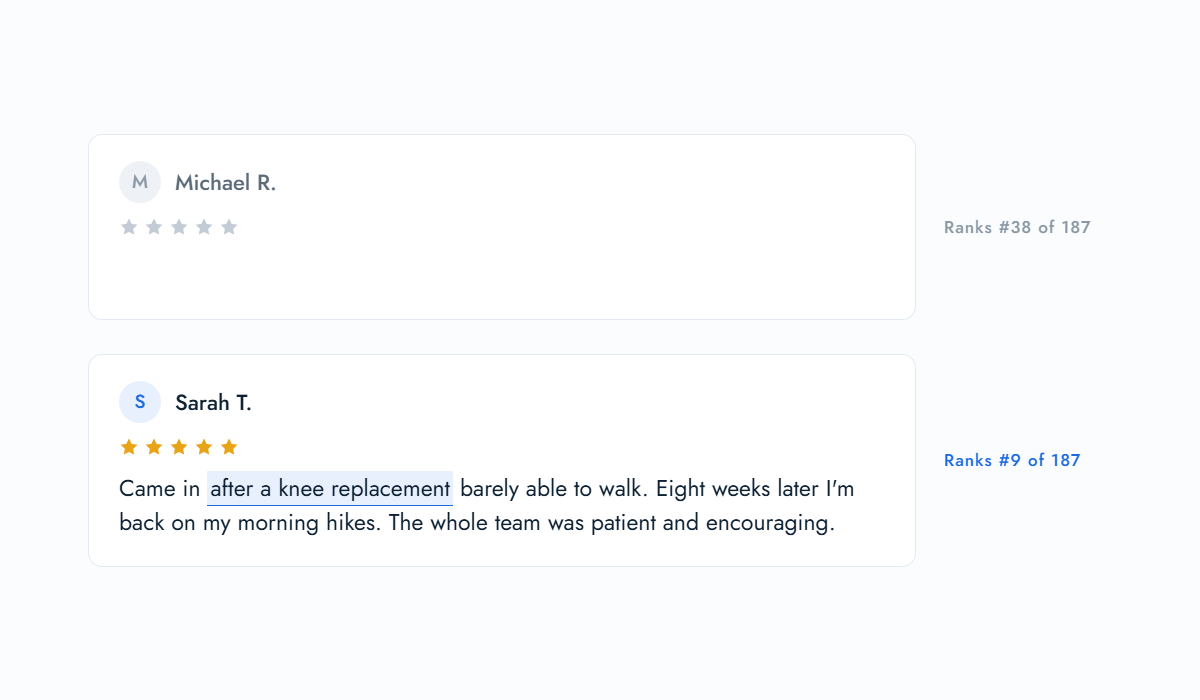
That's a gap of nearly thirty positions between a patient who writes two sentences and a patient who taps five stars and leaves.
It gets more specific. Keywords appearing inside your reviews rank 36th — meaningfully high on a list of 187.
So a review that says "Came in after a knee replacement and I'm walking normally again" does something a five-star tap can't. It tells Google what you actually treat.
What to do with this: when you ask, don't just ask for a review. Ask them to mention what they came in for. "If you don't mind writing a sentence about what we worked on, that helps other people find us" is a small change to the ask that materially changes the value of the result.
Three things you can stop worrying about
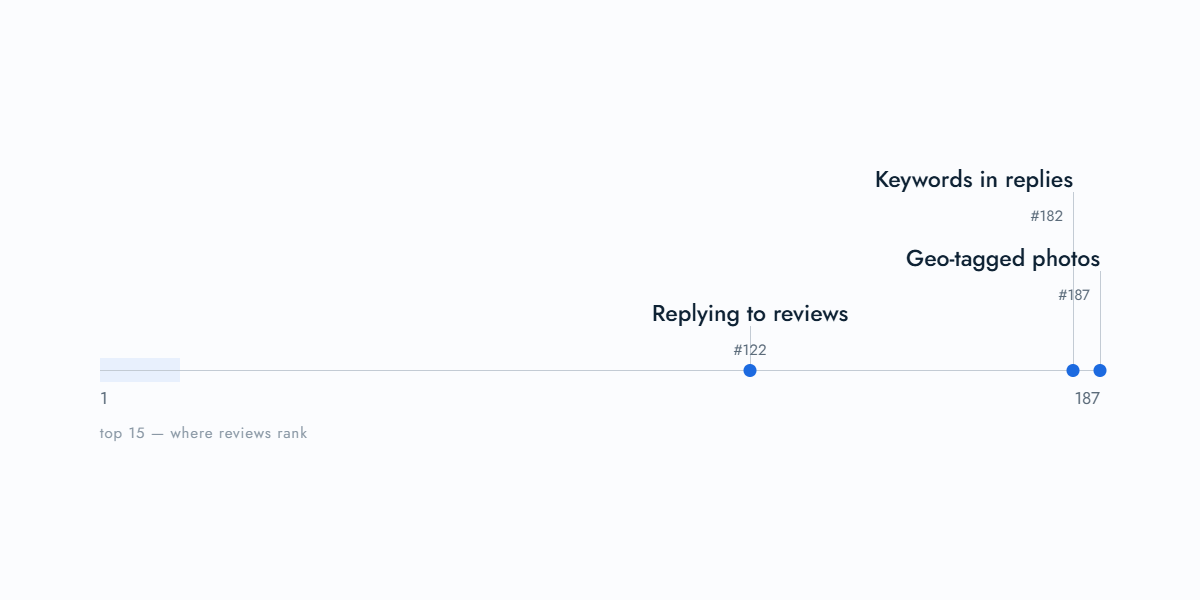
Commonly pushed. Rarely worth it.
This is where the primary data contradicts a lot of standard advice, and it's worth knowing so you don't waste effort.
Replying to reviews ranks 122nd out of 187.
Putting keywords in those replies ranks 182nd — deep into territory the report treats as myth.
Geo-tagging your photos ranks dead last, 187th of 187.
To be clear on the first one: responding to reviews is still worth doing. A prospective patient reading your profile sees an owner who engages, and that affects whether they call. But healthcare is a special case, and this is where generic marketing advice becomes actively risky.
HIPAA protects your patients' information regardless of what they've chosen to post publicly — and that protection extends to acknowledging that someone is your patient at all. Replying to a critical review with "I'm sorry your knee rehab didn't go as planned" confirms a treatment relationship in public. The safe pattern is a short, generic reply that neither confirms nor denies: something along the lines of "We take all feedback seriously and would welcome the chance to speak directly."
So reply for the patients reading, not for the algorithm — and keep every reply generic.
Google isn't the only place anymore
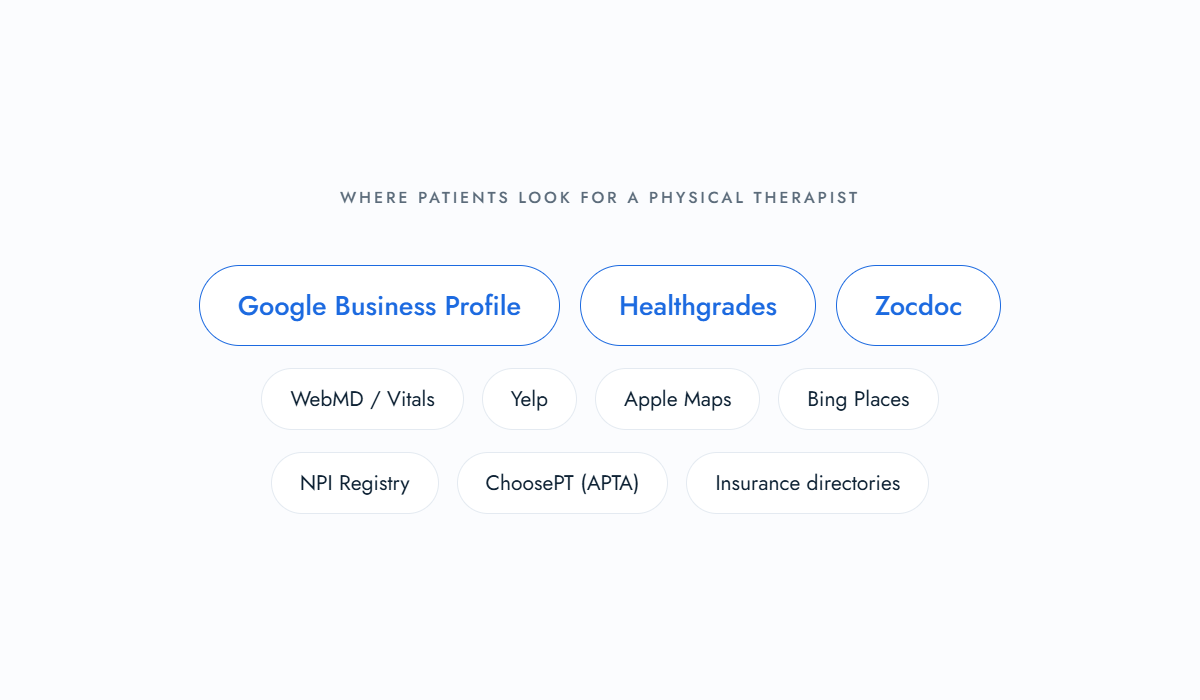
Google is the first stop. It isn't the only one.
One more finding worth acting on. In his recommendations for the year ahead, Shaw advises getting reviews on the prominent review sites in your industry — noting you can't just send review requests to Google anymore.
For a physical therapy practice, that means the healthcare-specific directories where patients actually look, not only your Google profile. If you have a specialty, the directories for that specialty matter more than general ones.
Why PT practices are unusually well positioned
Most local businesses are badly set up to collect reviews. A restaurant serves hundreds of people who never learn the owner's name.
A physical therapy practice has something rarer: eight to twelve appointments with the same person, and a natural ending. By discharge, a patient has spent weeks with you and knows your staff by name. They arrived unable to do something and they're leaving able to do it.
That's the strongest possible moment to ask — and unlike most businesses, it arrives on a predictable schedule with every single patient. Given how highly recency and sustained accumulation score, a practice that asks at every discharge has a structural advantage over one running occasional campaigns.
The raw material is already walking out your door. What's usually missing is the ask.
The system, in plain terms
Ask at discharge, in person. The last appointment is the moment, and it should come from the therapist who did the work.
Follow up with a text the same day, containing a direct link to your Google review page — not "look us up on Google." Every extra step costs you reviews.
Ask for a sentence, not just stars. Reviews with text outrank ratings without it by roughly thirty positions.
Keep it steady rather than bursty. The factor is explicitly "sustained influx of reviews over time, rather than bursts." A slow steady trickle is what the research rewards.
Never filter, buy, or incentivize. Screening patients so only happy ones reach Google — "review gating" — is prohibited by most review platforms. Purchased reviews get detected and removed, and take your credibility with them.
Incentives deserve their own warning in healthcare. Offering a discount or anything else of value in exchange for a review can implicate the federal Anti-Kickback Statute, which makes it a crime to use rewards of value to attract Medicare, Medicaid, or TRICARE beneficiaries — carrying felony exposure. If your practice bills Medicare, "leave us a review, get $10 off" isn't a marketing tactic, it's a legal risk. Ask everyone, incentivize no one.
Naturally, this isn't legal advice and you should check specifics with your own counsel or state board.
What to expect
Slower than you'd like. Local ranking improvement is a compounding process, not a switch, and the factors above reward consistency measured in months rather than weeks.
But the picture is considerably better than "impossible," which is where most practices file this. The clinic ranking above you usually isn't working harder than you are. They started asking earlier, and never stopped.
Want to know where you actually stand?
I'll look up the review counts and recency of the practices currently outranking you, compare them to yours, and tell you what the gap really looks like — along with anything else on your Google profile that's holding you back.
No pitch, no obligation. Just the numbers.