

Most small business owners have a website because they know they should — not because they're sure it's actually working. If that sounds familiar, you're not alone. And the frustrating part is that a website that looks fine on the surface can still be quietly sending potential customers elsewhere every single day.
Here are the signs to look for.
1. You can't remember the last time someone contacted you through it
This is the clearest signal. If your website has a contact form or a phone number and you genuinely can't remember the last time a new customer found you there — that's a problem worth paying attention to.
It doesn't mean your business is failing. It often just means your website isn't doing its job. People may be finding you, looking around, and leaving without taking any action — either because they couldn't figure out how to reach you, or because nothing on the page gave them a reason to.
2. There's no obvious next step for a visitor
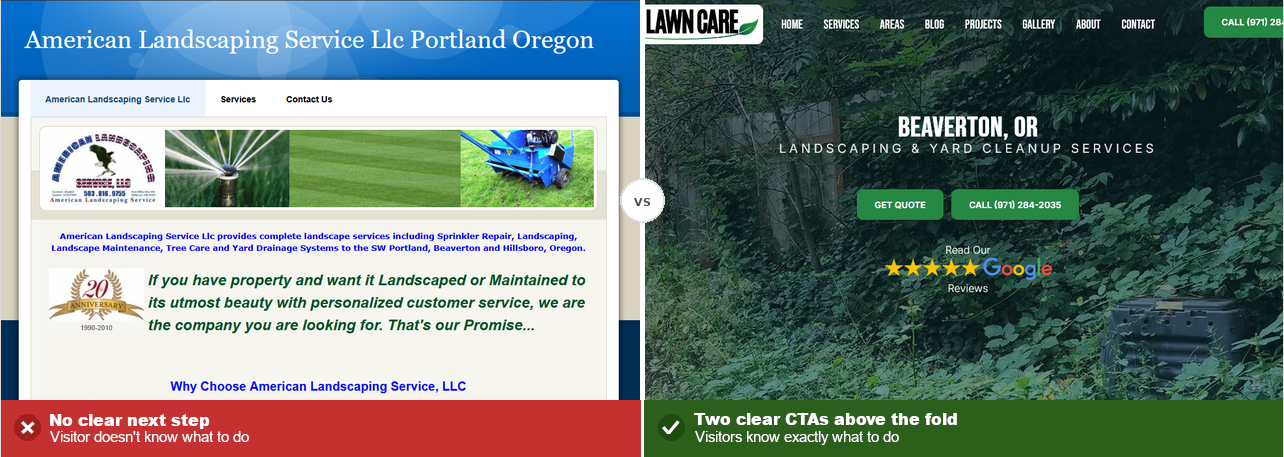
Left: visitors land and have no obvious next step. Right: two clear actions visible immediately.
Land on your homepage and ask yourself honestly: what is a visitor supposed to do next?
If the answer isn't immediately obvious — if there's no clear button, no simple way to book or call or inquire — then you're leaving it up to the visitor to figure it out on their own. Most won't bother. They'll click back and try the next result.
Every page on your website should have one clear action you want the visitor to take. Not five options. One.
3. It looks bad on a phone

More than half of all web traffic comes from mobile devices. If your website is hard to read, slow to load, or requires pinching and zooming on a phone — a significant portion of your visitors are having a bad experience and leaving before they've read a word.
The easiest way to check: pull up your website on your own phone right now. If anything feels clunky or hard to tap, your visitors are feeling the same thing.
4. You don't show up when people search for what you do
Type your service and your location into Google. Does your website appear? If not — or if it appears on page two or three — most people searching for what you offer will never find you.
This isn't just an SEO problem. It means every customer you get right now is coming from word of mouth, referrals, or platforms like Facebook — channels you don't own or control. Your website should be working alongside those channels, not sitting quietly in the background.
5. The last update was a long time ago
A website with a copyright year from three years ago, outdated team photos, or services you no longer offer sends a subtle but damaging signal: this business isn't paying attention. If they're not keeping their website current, what else are they not keeping up with?
Visitors make trust decisions quickly. Outdated content — even small things — erodes that trust before they've had a chance to consider hiring you.
6. You can't update it yourself
If making a small change to your website requires emailing someone, waiting for a reply, and hoping it gets done — your website is already working against you. Things will go out of date. Opportunities to add fresh content will be skipped because it's too much hassle. Over time, the site drifts further and further from reflecting your actual business.
A website you can manage yourself, even for simple things like updating your hours or adding a new service, is a fundamentally more useful tool.
7. You have no idea how many people visit it
You don't need to be obsessed with analytics. But having no idea whether ten people or a thousand people visit your website each month means you're making decisions in the dark. Is the site working? Getting worse? Which pages are people actually reading?
Basic analytics — Google Analytics is free — answers all of this. If it's not set up, you're flying blind.
What to do about it
If a few of these rang true, the good news is that none of them are permanent. A website that isn't working can be fixed — sometimes with small changes, sometimes with a more substantial redesign, but always with a clear understanding of what's actually wrong first.
The best starting point is an honest look at what your website is currently doing and where it's falling short. That's exactly what a free website review is for.
I'll take a look at your site and send you a plain-English report on what's working, what isn't, and what I'd prioritize fixing. No pitch, no pressure — just a straight answer.